
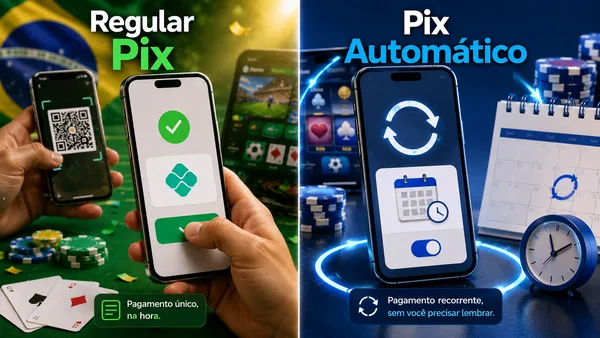
Pix Automático vs Regular Pix: What Automated Payments Mean for Brazilian iGaming in 2026
Pix has become closely tied to the way Brazilians move money online, and its role is especially visible in the regulated betting sector. Regular Pix gives players a fast, individual transfer that they approve each time, while Pix Automático introduces a different idea: one authorisation can support future recurring payments without a fresh confirmation for every charge. That distinction matters in 2026 because Brazil now has both a mature instant-payment system and a federally regulated betting market operating under strict rules for deposits, withdrawals, account ownership and responsible gambling. Pix Automático has been available since 16 June 2025 and continues to receive operational updates from Banco Central do Brasil. Yet its arrival does not mean that licensed betting sites can automatically turn recurring debits into routine player deposits. The payment rules applying to betting were designed around controlled transfers of the player’s own funds, making the relationship between automation and iGaming more complicated than it may first appear.
How Pix Automático Differs from Regular Pix in 2026
Regular Pix is essentially an individual instant payment. A player who wants to add money to an account on a licensed Brazilian betting site normally chooses Pix, receives the relevant payment details or QR code, opens the banking app, checks the transaction and approves it. The payment then travels through the Pix system and, once confirmed, can be credited to the player’s betting balance. Pix operates around the clock, including weekends and public holidays, and transfers normally reach the recipient within seconds. This combination of speed and direct bank-account access helps explain why Pix became such an important payment method long before Brazil’s federally regulated betting market formally began operating on 1 January 2025.
Pix Automático changes the approval stage rather than the underlying idea of a Pix transfer. The customer gives a company permission to send recurring payment requests under conditions shown during the authorisation process. Once permission has been confirmed in the customer’s bank or payment app, future eligible payments can be scheduled and settled without the customer manually approving every individual charge. Banco Central designed the service mainly for recurring commercial obligations such as utility bills, school fees, gym memberships, insurance and subscriptions. The payment therefore remains a Pix transaction, but the instruction comes from a previously approved recurring arrangement instead of a new customer action each time money is due.
The difference is important because Pix Automático is not simply regular Pix with an automatic button added to it. It has its own authorisation controls, scheduling rules and transaction limits. A customer can define a maximum amount for individual charges and manage active permissions through the bank. Under the current Banco Central operating rules, recurring arrangements can use weekly, monthly, quarterly, half-yearly or annual cycles. Customers can also cancel an authorisation, while a particular scheduled payment can generally be cancelled up to 23:59 on the day before settlement. These controls make Pix Automático suitable for predictable recurring payments, but betting deposits are not the same type of financial commitment as an electricity bill or monthly subscription.
From One-Off Confirmation to Standing Authorisation
The most significant change introduced by Pix Automático is the move from transaction-by-transaction consent to standing consent. With regular Pix, a player actively initiates or approves each deposit. The amount is visible during that specific payment journey, and the money does not leave the bank account until the player confirms the transfer. With Pix Automático, the important decision happens earlier. The customer accepts a recurring-payment arrangement and sets the conditions under which later charges may be processed. This can remove repeated payment steps, but it also changes how spending decisions are made because the transfer may occur well after the original authorisation was granted.
Banco Central has built several safeguards around this model. Before confirming an authorisation, the customer can see information about the recipient, the recurring arrangement and applicable payment conditions. Customers can set a maximum amount per charge, inspect scheduled payments and cancel an active permission. If a scheduled Pix Automático payment cannot be completed early in the settlement day because there are insufficient funds or an insufficient transaction limit, the payer’s institution must provide notification and make at least one further attempt later that day under the current operational rules. These procedures were refined again in June 2026, showing that Pix Automático is still being adjusted after its first year of operation.
There is another detail that becomes particularly important when the service is considered in an iGaming context. Pix Automático can, in ordinary commercial use, be configured so that a credit line associated with the customer’s transactional account may cover a payment when the available cash balance is insufficient. The customer can disable that use of credit for an authorisation. Brazilian betting rules, however, prohibit operators from accepting credit cards and other post-paid payment instruments and are designed to prevent gambling with credit supplied by operators or their partners. That does not automatically settle the legal treatment of every bank-funded Pix Automático transaction, but it creates a clear compliance issue that would have to be resolved before automated betting deposits could be treated like ordinary recurring bills.
Why Regular Pix Still Fits Brazil’s Regulated Betting Model
Brazilian betting payment rules are unusually specific about where player money may come from. Portaria Normativa SPA/MF No. 615 requires financial deposits to move electronically between an account previously registered by the bettor and the operator’s transactional account, with both accounts maintained by financial or payment institutions authorised by Banco Central do Brasil. The regulation recognises Pix, TED, debit or prepaid cards and book transfers within the same institution as permitted forms of electronic transfer. It prohibits cash, payment slips, cheques, cryptoassets, transfers from third parties, transfers from accounts that the player has not registered and post-paid payment instruments such as credit cards.
That framework suits regular Pix well. Each deposit can be linked to a specific player and to a registered source account, and the operator can wait for settlement before allowing the money to be used for a wager. This last point is also required by the rules: a bet cannot be made on the strength of money that has not yet been settled. In practical terms, regular Pix creates a clear sequence. The player chooses to deposit, initiates the transfer from the registered account, the payment is confirmed and the betting balance is updated. The process is quick, but the player’s decision still sits immediately before the movement of money.
Pix Automático does not fit that sequence as neatly because the player’s authorisation may have been granted days, weeks or months before a later debit occurs. As of August 2026, the public Brazilian betting rules do not establish a separate recurring-deposit regime specifically for Pix Automático. Nor has the Secretaria de Prêmios e Apostas publicly turned automated recurring betting deposits into a standard alternative to the existing one-off Pix process. Industry discussion during 2026 has consequently treated Pix Automático as a difficult fit for betting rather than an already established cashier method. Regular Pix therefore remains the more straightforward option for matching each deposit to the player’s registered account, available balance and immediate decision to fund betting activity.
Deposits, Withdrawals and Player-Account Controls
The importance of account matching extends beyond deposits. When an operator receives money from an account that has not been registered by the bettor, the amount must be returned rather than added to the player’s gambling balance. Third-party funding is also prohibited. These requirements reduce the scope for another person to finance betting through someone else’s account and help operators maintain a traceable relationship between the verified player, the payment source and the betting wallet. For regular Pix, this matching can be performed as part of each incoming transaction. Any future use of Pix Automático would still need to preserve the same relationship throughout the lifetime of the recurring authorisation.
Withdrawals are controlled as well. Under the federal rules, winnings are generally paid through an electronic transfer from the operator’s transactional account to the bettor’s previously registered account. The regulatory framework sets a maximum period of 120 minutes after the relevant sporting event or online-game session for payment of prizes, subject to specific permitted exceptions. A player can also choose to leave winnings recorded in the betting balance for subsequent use with the same operator. Pix is particularly suited to withdrawals because it can deliver money directly to a verified bank or payment account without introducing a separate payment route.
For players, these rules mean that the speed of a payment method is only one part of the experience. Source-of-funds checks, account ownership, identity controls and responsible-gambling settings remain relevant even when the transfer itself takes only seconds. For operators, the payment record must also fit into a wider audit trail. Brazilian betting businesses are required to retain extensive player and transaction data and send standardised information to the betting regulator through its reporting arrangements. An automated payment cannot therefore be treated as an isolated banking event. It has to be reconciled with the correct player account, payment history, gambling balance and regulatory records.

What Pix Automático Could Change for Brazilian iGaming
If regulators eventually provide a clearer route for recurring Pix payments in regulated betting, the biggest change would be the reduction of repeated deposit steps. A returning player would no longer necessarily have to generate a fresh Pix payment request and confirm the transfer in the banking app every time funds were added. Technically, this could shorten the distance between a standing authorisation and a completed payment. For ordinary subscription businesses, that reduction in friction is one of the main reasons Pix Automático exists. In gambling, however, reducing friction has to be balanced against rules intended to keep spending deliberate, traceable and within limits chosen by the player.
This is where Brazil’s responsible-gambling requirements become central. Licensed operators must provide tools that allow players to set limits on deposits and betting and must make self-exclusion controls available. They are also expected to identify player profiles and monitor behaviour for signs that may indicate harmful gambling. A recurring bank authorisation cannot replace those controls. Even if the banking side permits a payment of a certain value, the gambling account may have a lower deposit limit or another restriction that prevents the money from being accepted. A sensible future arrangement would therefore need the operator’s responsible-gambling controls to take priority over the amount or frequency permitted by the Pix authorisation.
Automation also changes the behavioural context of a deposit. With regular Pix, the player makes an immediate decision to move a specific amount into the gambling account. With a recurring debit, the decision may have been made at an earlier time when the player’s financial circumstances or gambling behaviour were different. That gap is particularly relevant when spending limits have subsequently been reduced, the account has entered a cooling-off period or the player has requested self-exclusion. Any workable automated model would need to stop future payments quickly when the gambling account is no longer eligible to receive them. Convenience alone would not justify allowing a previously granted bank permission to override newer player-protection settings.
The Realistic 2026 Outlook for Operators and Players
For 2026, the practical distinction is therefore fairly clear. Regular Pix is already closely aligned with the regulated betting payment process: the player initiates a transfer from a registered account, the operator confirms receipt and the funds can then be used. Pix Automático is a broader recurring-payment service whose banking infrastructure is operational, but its use for automated gambling deposits raises questions that ordinary subscription businesses do not face. These include the timing of player consent, deposit-limit enforcement, self-exclusion, the possible use of bank credit and the need to establish that every debit still complies with SPA requirements when it is actually settled.
Banco Central continues to refine Pix Automático itself. In June 2026 it amended operational provisions dealing with the scheduling and settlement of payment orders, and further technical documentation was updated in August 2026. Those changes show that the service is becoming a permanent part of Brazil’s payment environment rather than a short-lived experiment. They do not, however, amount to gambling-specific approval. Licensed betting operators still need to work within the rules issued by the Secretaria de Prêmios e Apostas, while banks and payment institutions remain responsible for applying the rules governing Pix. The fact that both sets of requirements exist at the same time is why a technically possible payment flow is not necessarily an immediately suitable betting flow.
For Brazilian players, the safest assumption in 2026 is that Pix Automático and regular Pix serve different purposes. Regular Pix remains the natural choice when a person deliberately wants to make an individual deposit or receive a withdrawal from an authorised betting site. Pix Automático is useful for genuine recurring commercial payments where one continuing authorisation makes sense. Its technology could influence future iGaming payment design, especially around reusable permissions and simpler bank connections, but automated gambling deposits require more than technical availability. They need clear regulatory treatment, strict account matching, cash-based funding, effective player limits and immediate interaction with self-exclusion and other responsible-gambling controls before they can offer the same regulatory certainty that regular Pix already provides.